I am traveling in San Francisco this week to film a couple work-along classes that will be released soon. I am enjoying spending my week drawing during the filming. I am delighted by reminding myself of all the things I love about drawing, reminded that teaching others is a great way to teach yourself.
All in all, this makes me want more time in my day to day to enjoy these little moments. Whether it is with my family or simply taking the time to sip and enjoy the cup of coffee in my hand. I see it as the job of the objects I make and the objects I design to help others slow down, take a second look and enjoy the things we live with and often take for granted. I want to help make the world a happier and more beautiful place.
Its good to get out of my little world at home and see my life a little bit more objectively. All this is leading to looking, thinking and ultimately I am working on revising my master plan. More to come soon!
My first book is about to hit shelves in March and my second is coming only a short time after in July! My second book is published by Quarry. Here is a bit of info about the book:
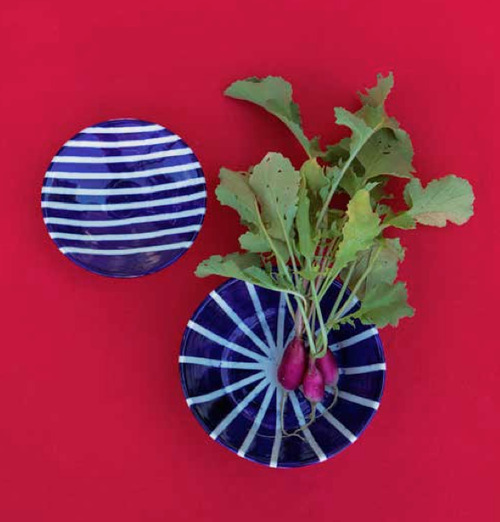
New Ceramic Surface Designis a fully-illustrated manual covering a wide range of creative surface decoration techniques presented in an approachable and accessible format. Ceramic artist and expert Molly Hatch guides beginners and more advanced ceramicists through various methods for creating designs on clay. You will be introduced to several different and new approaches for using your own imagery and content on the ceramic surface. Techniques include Mishima, tape resists, rubber stamping, and doodling to create line art, stamping, nature resists, found objects, and shellac resists to create textures, and sticker resists, contact paper stencils, paper resists, and Sgrafitto to create shaped designs. Detailed photography and hand-drawn illustrations document the processes and show beautiful completed samples. Templates and stencils for all the featured designs are included in the back of the book to use as is, or to tailor to your own tastes.
New Ceramic Surface Design shows you a great technqiue to complete your clay projects utilizing easily accessible materials, like washi paper tape.
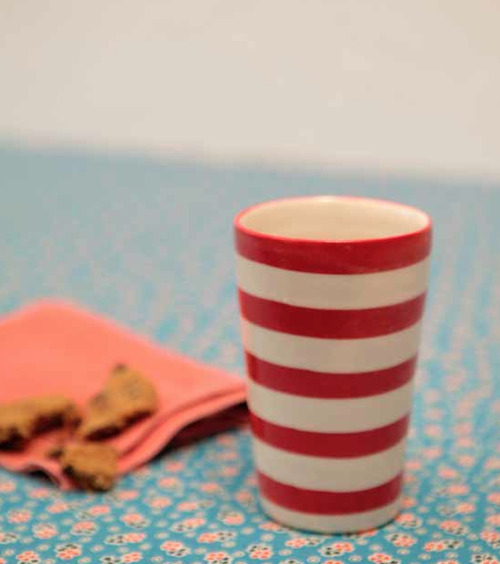
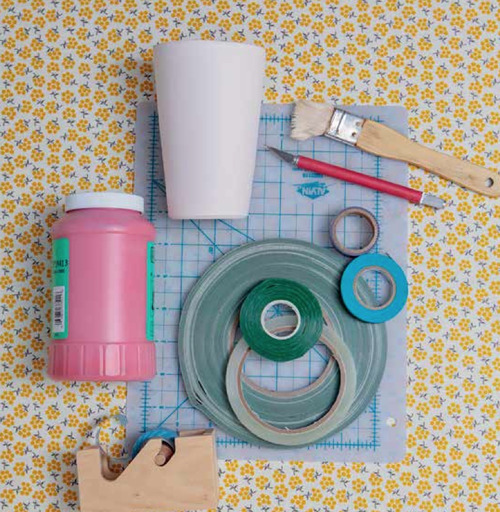
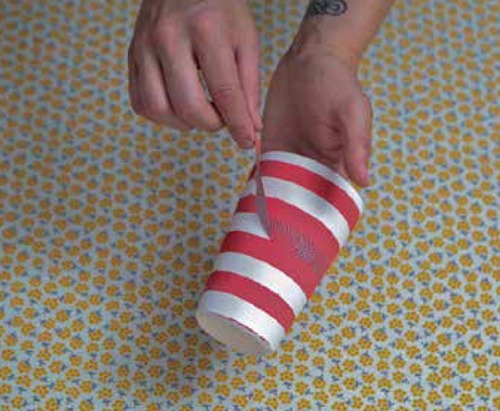
Masking tape, washi paper tape—these are easily accessible materials and make for a great surface decoration tool on bisque-fired ceramics. I prefer to use washi tape as a resist, because it is easy to tear from the roll and remove from the surface of the bisque without leaving a residue behind. Most often, I use washi tape to create stripes in my work. It leaves a clean line with little to no cleanup required. Using washi tape as a resist is an easy way to get a straight line or controlled curved line on the ceramic surface. Using tape as a resist in ceramics is similar to using painter’s tape when masking off edges on a wall when painting your home. Use it to block out areas of decoration or to designate a clear edge when decorating work. The uses for tape as a resist are infinite!
1. Clean your bisque piece with a damp sponge to remove any dust from the surface. This will help the tape stick nicely as well as prep the piece for adding underglaze and glaze.
2. Using a craft knife and a cutting mat, cut a length of tape that will fit the length of the surface of the form that you wish to block. Trim the tape if needed. You are using the washi tape as a resist, so wherever you put it on the surface, it will prevent the underglaze from soaking into the clay.
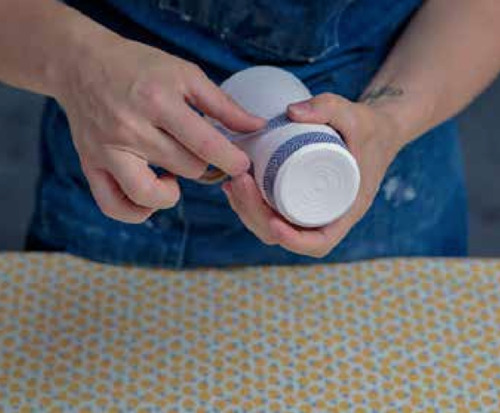
3. When adhering the tape to the clean bisque, be sure to smooth the tape onto the ceramic surface carefully; it may buckle as it moves over the surface of a form. Wherever the tape buckles or creases, there is a good chance that underglaze will seep under the tape and require cleanup.
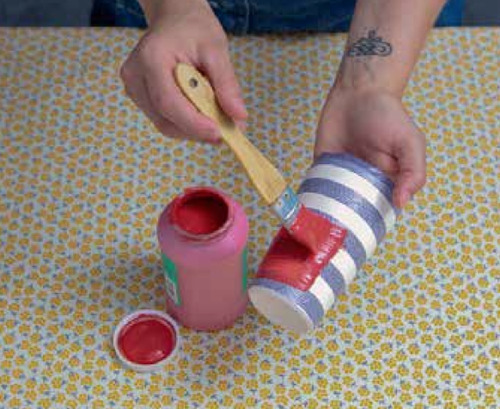
4. Once all of the tape is in place, use a paintbrush to apply your full-strength underglaze color over the surface of the bisque. Apply two or three coats of underglaze to achieve
5. Allow the underglaze to dry fully. Once dry, carefully re- move the tape to reveal the stripe! Finish the piece with a clear or tinted clear glaze.
Tip
Sometimes the underglaze gets beneath the tape, creating an irregular line. This can be a happy accident or a problem. If you would like to remove the extra underglaze, gently scrape the surface of the bisque using the tip of a craft knife blade or a spear-tipped sgraffito tool. This will easily remove the spots where the underglaze seeped beneath your tape.
Try it!
Try using the tape as you would use painter’s tape—to create a straight edge to a field of color. This can be a great way to color block on a form. You can also try cutting a wavy shape into the tape for a clean line that isn’t as straight. You can get creative here. Alter the tape by cutting it into an asymmetric form. You could even create a grid or check pattern by layering the tape!
I wanted to share a few images taken this week during my visit to WCU in North Carolina. I was blown away by the student and faculty hospitality, warmth and enthusiasm and thoroughly enjoyed my time here! A big thank you to everyone involved in making this week so amazing for me!
I want to share some pages from my very first book! A Teacup Collection is my artistic catalog and painterly reflection of the 18th century teacups in the Clark Art Institute collection in Williamstown, MA.
Below is a preview of some of the essays and the pages of the book:
I am delighted by the responses and dialogues happening in Think Big! Ben and I worked so hard to bring together this series of interviews and worksheets and it is enormously rewarding to see that it is paying off for participants!We have almost 250 people enrolled in the series from all over the world, I love that we can have conversations across borders and languages. I wanted to share a teeny tiny look at just a few of the many exciting discussions, comments and info that is being changed as a part of the series.
Ben and I are winding down our video postings with the last one going up next week, but there is so much coming out of this series, its incredibly exciting. We are already talking about Part 2, as well as what it would be to have an in-person weekend symposium around these topics.
I also wanted to remind those of you still considering the series, you can still enroll until February 12th and have access for 6 weeks! All of the videos and downloads will be available by February 12th, so you can watch the whole series at your own pace. CLICK HERE TO REGISTER NOW!
Here are some snippets from the discussion groups:
"I just finished listening to the reflection video (on licensing) and I'm so glad that Molly addressed the importance of a company's integrity. It's the first question/concern that popped into my head, though I was thinking more of the production environment and the environmental impact. "
"My goal is to start my brand but I din’t really know where I fit in this course as I’m more of a designer and just recently started making ceramics. But when Klein and Reid referred to themselves as a design firm it got me really inspired. Such a wealth of information in this course and I’m getting lots out of it. "
"BTW, Molly and Ben, so funny, I have been obsessively listening to "after the jump" at work every evening for the last few weeks! The series she did on productivity was amazing, and I have learned so much. I am so glad that you shared with the class, and want to encourage you all do download the heck out of that podcast! (and ben's too) "
"Really interesting to hear the difference between a partnership with a gallery and the partnerhsip with an agent. I was operating under the mis-conception that the agent was participating in building demand and making work relevant. This really puts the responsibility back on the artist/entrepreneur to do quite a bit of development on their own. Would be interested to hear positive examples of intermediate steps. This course is one. But how have people found help/guidance/leadership for even getting to the point where they are entertaining positive retail experiences that THEN get you in the arena with agents?"
This photo from the summer perfectly captures the peace and quiet of my home studio that fosters the making of my work. It reminds me of the time I had set aside to work on my surface book, and how great that felt earlier this year.
With the recent move of my ceramic studio to a new building at the beginning of January, I am facing the challenges of setting up my studio to best meet my needs. I have forgotten the little challenges that arise when moving into a new space--and in re-arranging an existing space (I have kept my home-studio for drawing and painting and computer work). I have been working to rewire to make kilns work, finding enough chairs and work tables, drapes for projecting--and even negotiating relationships with my new neighbors (last week I dumped a bucket of water and it went right through my floor onto my downstairs neighbor! Not exactly how I had envisioned meeting her!).
I'm working hard to settle into two new studio spaces with a new making routine in each and at a time when I'm busier and more in demand than ever both with my one of a kind artwork and with my brand. Today, I'm feeling overhwhelmed by all that is going on--but also thankful I have so much choice and so many opportunities in an art career that is supporting me and my family.
I have reached a point where I'm having to pull back from saying "yes" to so much and start advicating for a bit more balance. This is such a scary place to be--saying "no" or "not now" always feels like I'm shutting a door on a great opportunity. Intellectually I understand that my fear of shutting doors on opportunities shouldn't govern my decisions, but in reality it sometimes does. I am going to continue to strive to re-center myself and push aside this fear. While I don't believe true balance is achievable, I do believe that I can start to trust that my business is going to continue to support me and that setting aside enough time for each project I'm working on will result in good work and good designs....wish me luck!